
Barter, patronage, and other artist economies
Alternative markets and support for following the work

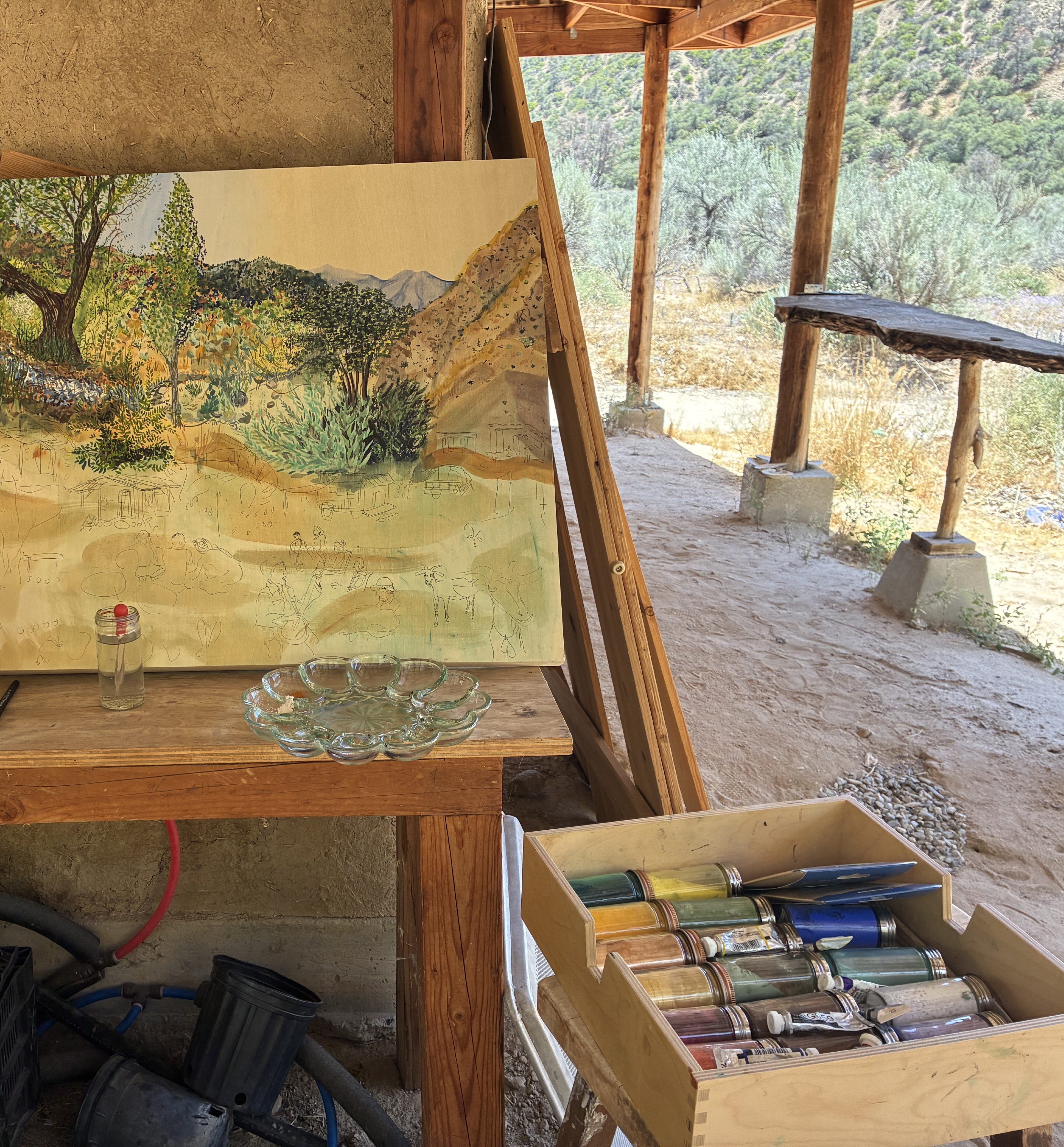
Last week I was listening and painting at an ecovillage, grown in relation with the land. They haven’t built on it, but inside of it. The homes and daily life processes hum in seasons with sagebrush habitat, creatures, and a pulsing spring.
This DIY residency came from a calling: an alignment of people, place, and Earth movement in practice. So many of us dream of intentional communities. Witnessing a window of one’s reality there gifted me a real-life example to portray.
It’s tough to build living systems on sandy soil in the high desert where the groundwater’s been drained by neighboring corporate “organic” farms leaking water at high noon, zapping the aquifer dry. And, just like anytime humans gather, there are relations that grow sensitive to the climate’s and economy’s demands. Still, they have built earthen structures, grow food, recycle waste, and generate a pedagogical framework of care.
So, the painting pulled me in. Wind told me to go; my heart implored me to follow this thread. The kin I belong to there conspired to make it possible.
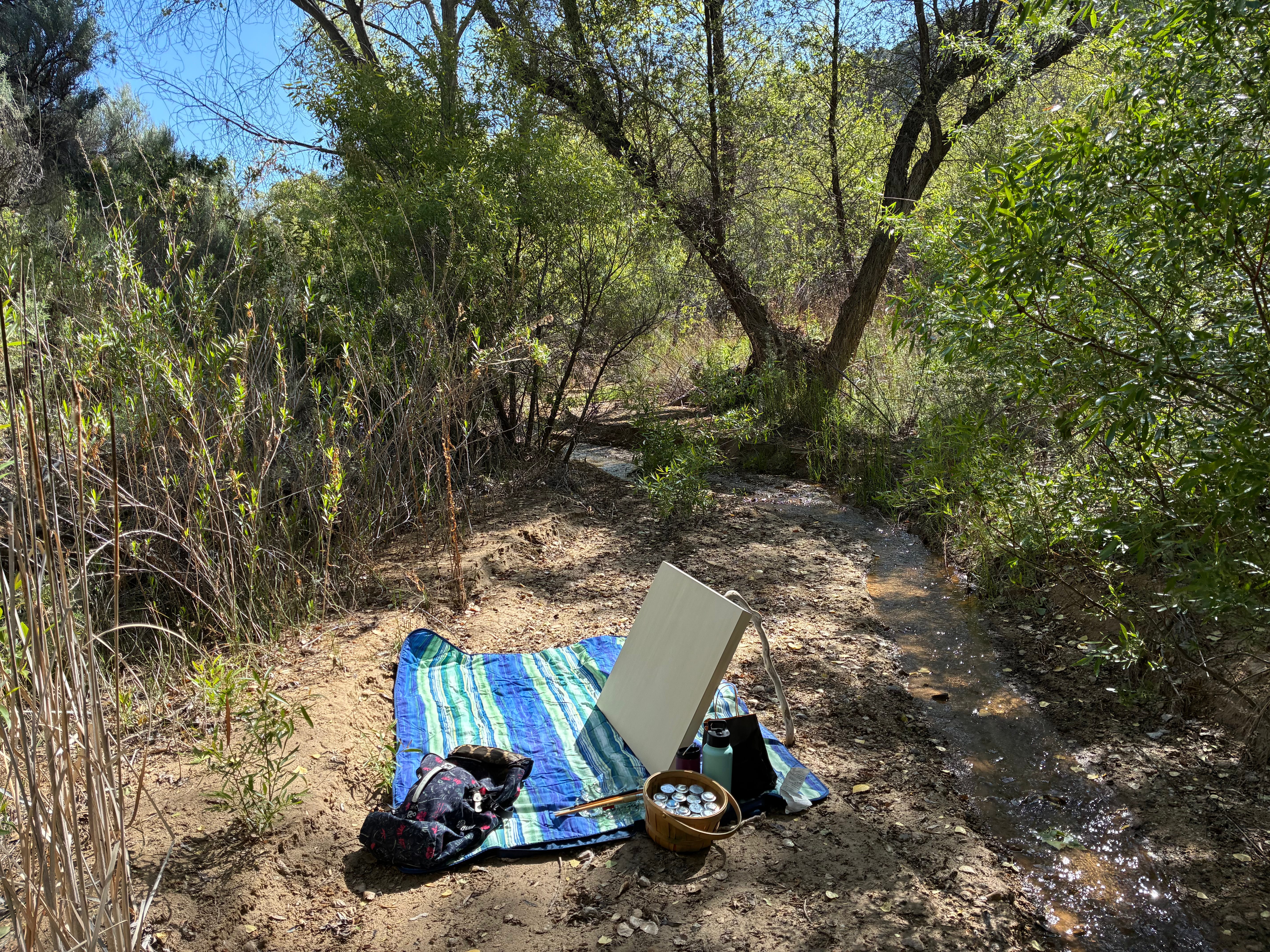
“Are you getting paid?” is a frequent and understandable question I get when people learn of the collaborative storymaps I’m making with Indigenous movement and ecommunities. It gives me pause; I start to shrink in shame that it’s not the immediate pay one might expect. The payment, however, comes in many forms:
learning new earthwork skills on-site
unplugging from the city hustle and relishing in seeing the milky way
one week to partake in daily life with my bestie out there
animal therapy in the form of goat walks, kitty cuddles, and quail conversation
the bliss of visiting a spring feeding the valley floor, asking her what story she’d like me to tell
the ceremony a visiting indigenous group invited us to participate in
three delicious meals a day, often made in elaborate menus of whole ingredient
nervous system reset from earlier bedtimes, infrequent cell signals, and slower time
future visibility when the painting and its print sale meet their masses
future dividends should we split said painting and print sale
a body of work building a window into real-time paradigm shift as planet
Examples of dwelling, farming, waste, and water systems that nurture and uplift the local ecosystem rather than deplete it
seasonal hues of buoyant desert bloom
These intrinsic values are vast. I return to my soul, a deep spirit place. I come back feeling restored. I get to play with gongs and kittens and cottonwoods while listening, learning, building up the background.
So, how does one make a living at this?
For me, a lattice of support unfolds as I take my next step. This trust can be challenging to shape and maintain, yet here I am, crafting an artist’s life as a parent 23 years later.
1. Barter for meeting basic needs and big costs
This one is a mercurial art that involves putting special requests out to the Universe, speaking this dream visions out loud to community members who might know someone or something of alignment, and catching the opportunity that comes.
For the past 14 years, I’ve kept housing costs from zero to low through creative arrangements and barters. Whether teaching Spanish in exchange for utilities, squatting on private but unmonitored land, nannying a child, or stewarding the land; I prefer gifting labor to pouring money into rent.
One day a week of tending to soil or baby feels more accessible to me that long hours at a desk or company or computer. This isn’t for everyone, but it’s been a blessing for me to free up time for parenting, painting, and ceremony.
Disadvantages: housing can become contingent on what an able body can produce. It could get easily get taken away by landlord or owner. This can mean tenuous housing security. It can also mean accepting conditions of the home or land that are out of my hands. It might imply having to shrink or adapt to someone else’s control and ideation of the space, and quickly pivoting when circumstances take an unexpected turn.
Advantages: I keep overhead low and maximize time with my daughter. I pursue the path of painting that Pachamama calls me to. I spend a lot of time outdoors, co-regulating, regenerating, and learning from habitat. If one can find skills that feel aligned and mutually abundant/helpful a crack opens in the rent on stolen land scam.
2.) Cultivate niche patrons for your art
One art market is marked by speculation and insider trading. There are infinite others that can intersect and depart from that main stream. Patronage via platforms like this (thank you, thank you to the paying and founding members here). There is a scaffolding of art pricing - from original works to reproductions - that can make its collecting accessible to a broad array of people.
For me, two decades deep, niche patrons have collected my work. They tend to be women, ecofeminist, and/or interested in the integrity of the socio-environmental practices and collaborative ritual that go into my visual art output. They tend not to purchase a work for its market value, but for an intrinsic value. They are following a quality that the painting emanates. The way it feels to be enveloped in a scene, trailing the story held within. They are purchasing for the transformative power of a painting, rather than contemporary trend.
Disadvantages: It can be hard to connect with patrons when just starting out, especially when there are class barriers for high cost works. Sales can be sporadic and hard to plan for. My time at UCLA’s MFA program, for example, gave me an initial boost of visibility for LA-based patrons.
Advantages: social media, word of mouth, and community exhibitions can help broaden one’s reach outside of more formal art world settings. Consistently sharing works on a social media account that links to one’s artist website can cultivate broad audiences for one’s work, especially if there are multiple price tiers for folks to peruse.
3. Steady income streams from offerings
To supplement unpredictable art sales, we can generate classes, cohorts, and services as consistent income. There are often steady opportunities via part-time work for reliably pay the bills. Our works are connected through broad strokes of meaning-making and the teaching can feed the painting which feeds the movement. A pedagogical practice is creative praxis, too.
For me, this has primarily come through the DIY PhD program. Offering sliding-scale tuition for an 8-month course has been the most reliable source of income for my family. The cosmology maps and multi-species community connections we make in class are deeply tied to the visual expressions of my work. They feed each other; making a place for world-building and meaning that can ripple impact far beyond me.
Disadvantages: One wears even more hats upon starting businesses; the marketing, logistics, enrollment, payroll, AND curricula departments can be a lot. (Co-founding a cooperative school helped me to lift some of this multi-modal burden.) One can hire help at a certain point. Consistency in communication can be challenging for me as I follow deer trails and aquifer lines. It takes discipline to be my own task-master. I’m not great at many aspects of running a business; but the service still feels strong.
Advantages: Flexibility! Make your own calendar. Map offerings with your personal rhythms and work habits. Prioritize body, mind, spirit, habitat, and community. Share what you truly believe in, cultivating values-aligned networks and expressions of your medicine. Finding a sweet spot of seasonal long-term and short-term offerings can expand one’s reach and shimmer with new collaborations and connections!
What about you? Do any of these resonate? What’s your experience of crafting an economy in the mainstream and/or margins of capitalism’s decline? I’d love to hear your thoughts 🦌
So inspiring!!! Love the abundance of advantages details in describing your residencies!!!